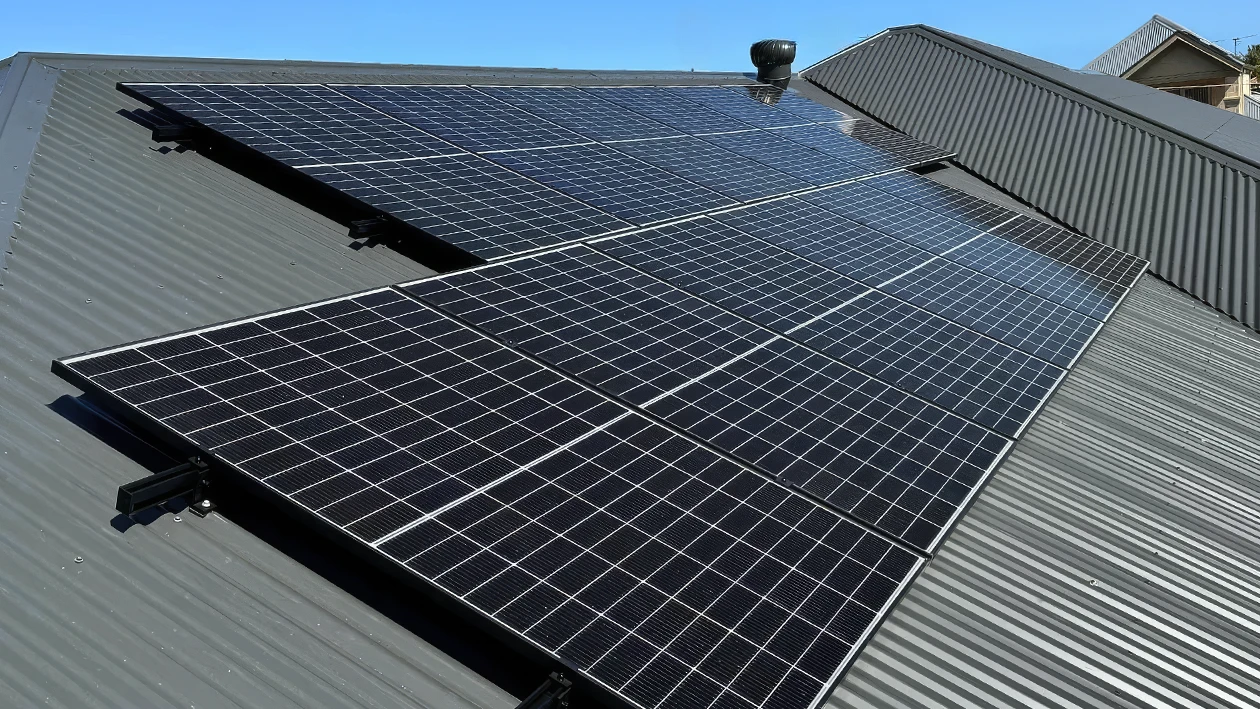
The average new rooftop system in NSW is now 9.9kW. Clean Energy Regulator data analysed by the Australian Energy Council puts it there, counting residential and commercial installs together, with the national average for standalone installations at 9.8kW across 2024. A 10kW system is no longer the upgrade option. It is close to the standard one.
For larger NSW households, that usually means 21 to 25 modern panels depending on wattage, paired with an appropriately sized inverter. On the Central Coast, a well-positioned 10kW array generates roughly 35kWh to 45kWh a day averaged across the year. Production swings with the season, roof orientation, shading, panel angle and system losses, so treat that range as a planning figure rather than a guarantee.
That capacity suits a large four-bedroom home, a household charging an electric vehicle, or anyone planning to add 10kWh to 15kWh of battery storage.
The shift towards larger systems is driven by what households are plugging in. A 6.6kW system covers a typical home on standard appliances. Add ducted air conditioning, a pool pump, an EV charger, electric hot water or a battery, and 10kW becomes the sensible starting point.
6.6kW vs 10kW: which size do you actually need?
A 6.6kW suits a smaller household with moderate electricity use. 10kW fits a larger household, particularly one with high daytime consumption, an EV, a pool, or battery plans.
The right answer depends on when you use electricity, not just how much shows up on your bill. You can compare the full range of options on our solar systems page.
The 2026 sizing and cost matrix
| System | Best for | Daily output | 2026 installed cost |
|---|---|---|---|
| 6.6kW | 2 to 3 occupants | ~26kWh/day | $5,000 to $6,000 |
| 10kW | 4 to 5 occupants, EVs | ~40kWh/day | $8,000 to $10,500 |
| 16kWh battery (add-on) | Heavy night-time usage | Stores ~16kWh | $8,000 to $12,500 |
These are indicative NSW prices including GST and the usual upfront Small-scale Technology Certificate discount. Panel and inverter brands, roof access, switchboard work, metering, backup capability and battery configuration all move the final number. Choosing microinverters over a string inverter is one of the bigger swings, and the gap widens as you add panels. Our string inverter vs microinverter comparison covers the trade-offs. A 10kW system with around 16kWh of storage typically lands between $15,000 and $25,000 installed. For a current breakdown, see our guide to solar battery costs in NSW, and our finance options if you would rather spread the cost.
Neither size makes a home fully off-grid on its own. Off-grid operation needs a designed combination of solar, usable battery capacity, backup equipment and load management.
Two questions get you most of the way there. Does your household regularly use more than about 25kWh a day? And are you planning to add an EV, a battery or another major electric appliance? If either answer is yes, ask your installer to model both a 6.6kW and a 10kW option. If your usage is modest and unlikely to grow, the smaller system will probably return more.
Adding capacity later means additional labour, fresh approvals and sometimes an inverter change. Size for the next five to ten years, not for last quarter’s bill.
Do this now: find the “average daily usage” figure on your most recent power bill. Then pull an older bill from the opposite season. The annual average matters, but the summer-to-winter spread matters just as much.
The 20% rule and how to pair panels with a battery
Your array should generate about 20% more than the household consumes. That is the 20% rule, and it is the industry’s standard starting buffer. It absorbs winter shortfalls, gradual panel degradation and normal system losses, so the system holds up on its worst days rather than its best.
It is a first estimate, not a design. A proper design also accounts for your location, roof direction, shading, seasonal demand, daytime consumption and any network export limit.
The sizing formula
Step 1. Calculate your base need. Find your average daily usage in kWh, comparing summer and winter bills rather than a single billing period. Say it averages 30kWh a day.
Step 2. Apply the 20% rule. Multiply by 1.2. Your generation target is 36kWh a day.
Step 3. Divide by peak sun hours. Divide 36kWh by 4, the working figure for average Australian peak sun hours. That gives you roughly 9kW of panels, which in practice means a 10kW system, since panels come in fixed increments.
Step 4. Sense-check it against your usage pattern. The formula sizes the array. It does not tell you whether the investment pays. If most of your consumption happens after dark and you have no battery, a large share of that 36kWh gets exported at a low rate, and a smaller system paired with load shifting will often do better.
Battery pairing strategy
A 10kW array pairs well with a battery in the 16kWh to 25kWh range, particularly where evening consumption is heavy. Our guide on what size solar battery you need works through this in more detail.
Advertised capacity is only part of the picture. Your installer should be working from usable capacity, maximum charge and discharge power, your evening and overnight demand, backup requirements, winter production, whether the battery is AC or DC coupled, and the manufacturer’s compatibility requirements for your inverter.
The principle worth remembering: panels generate the energy, the battery only stores it. An oversized battery on an undersized or shaded array will not fill through winter.
The reverse holds too. More panels is not automatically the answer. If the extra production mostly gets exported at 3.4c, ask your installer to model the actual saving before you pay for it. Worth checking the NSW solar battery rebate before you commit, since it changes the numbers considerably.
Do this now: check whether your retailer or energy app gives you half-hourly usage data, then look at when consumption peaks. Daytime peaks argue for a larger array. Evening peaks argue for a battery.
The 120% rule: can your switchboard handle a 10kW system?
The 120% rule is the electrical safety principle behind switchboard assessment. Combined grid supply and solar backfeed must not exceed 120% of the switchboard’s busbar rating, because anything beyond that risks overheating the board.
It is a real constraint and it catches people out, usually after they have already settled on a system size. It is also not something you can resolve from the label on the front of the board. Phase configuration, cabling, voltage rise and the network’s own connection requirements all feed into the answer.
Do not remove switchboard covers or inspect busbars yourself. A licensed electrician or accredited solar installer does this assessment.
What you can check before requesting a quote
Step 1. Confirm whether your property is single-phase or three-phase. Your bill or meter may show it. Ask an electrician if it is unclear.
Step 2. Photograph the outside of the switchboard and the visible breaker labels, covers on.
Step 3. List your large electrical loads for the installer: ducted air conditioning, induction cooking, electric hot water, pool equipment, EV charging.
Step 4. Ask the installer to confirm switchboard capacity, network approval requirements and any proposed export controls in writing. Our warranty terms set out what we cover on workmanship and equipment.
What that means in practice
In the Ausgrid network area, which covers much of the Central Coast and Lake Macquarie, systems up to 10kW of inverter capacity per phase currently qualify for the streamlined connection process, subject to the requirements that apply to your property. Every new or altered grid-connected solar and battery system still needs network approval before energisation.
A 10kW system does not automatically require three-phase power or a full switchboard replacement. An upgrade becomes necessary when the existing equipment is outdated, damaged, non-compliant or not rated for the proposed install.
Export limiting is another possible outcome. It caps how much solar electricity flows into the grid, and it is a network solution rather than an electrical one. It does not remove the need to confirm the switchboard, cabling and protection equipment are suitable.
Your quote should state each of these separately: panel capacity, inverter capacity, approved export limit, any switchboard or metering upgrades, and whether the system must meet current smart-inverter or emergency backstop requirements.
Why your bill is still high after going solar
You are exporting cheap daytime electricity and buying it back in the evening at full retail rates. The system is working. The timing is not.
The numbers make this concrete for Central Coast households. For 1 July 2026 to 30 June 2027, IPART set the NSW all-day feed-in benchmark at 3.4c to 6.5c per kWh, down from 4.8c to 7.3c the year before. Its time-of-day benchmark for the Ausgrid network values evening exports between 4pm and 9pm at 17.2c to 18.7c per kWh. Your midday power is worth a fifth to a third of your evening power, and both sit well below what you pay to buy electricity back.
These are benchmarks, not mandated rates. Retailers pay above or below them, and plans advertising high feed-in tariffs often carry higher usage charges to match. Read the whole offer.
The gap between export value and retail price is the argument for using more of your own solar inside the house, either by shifting appliances into daylight hours or by storing the excess. Before buying a battery, compare its installed cost against the value of the grid electricity it displaces. Backup and energy independence are worth something on their own, but the financial return depends entirely on your usage pattern and tariff. The rebates currently available in NSW shift that calculation, so factor them in before you decide.
The four-step solar audit
Step 1. Check for inverter faults. Look at the inverter or the monitoring app in the middle of a sunny day. A warning light, an error message or unexpectedly low production means the system needs attention, and it can sit that way for weeks unnoticed. Our solar panel maintenance service covers this kind of check.
Step 2. Shift your timers. Run the pool pump, dishwasher and washing machine during solar production hours. Stagger the larger appliances rather than starting everything at once. This costs nothing and it is the highest-impact change most households can make.
Step 3. Check inverter performance, not the ratio. Panel capacity exceeding the inverter’s rated AC output is normal and deliberate, because it keeps the inverter working efficiently in lower light. Brief clipping on very sunny days is expected. Persistent or heavy clipping justifies a professional performance review, but do not diagnose the system from the panel-to-inverter ratio alone.
Step 4. Audit your hot water. Electric hot water systems often heat overnight on grid power. A timer, a diverter or a controlled solar-heating arrangement can move that load into daylight, though the right option depends on your tariff and equipment. Have an electrician confirm it before you change a controlled-load arrangement.
One more thing worth ruling out: dirty panels. Salt, dust and bird mess reduce output more than most people expect, and panel cleaning is a cheap first step before you start suspecting the equipment.
Most households that shift their flexible loads into daylight see a clear drop in grid purchases within a billing cycle or two, with the size of the drop depending on tariff and consumption pattern.
Is a 10kW system worth it?
For a four or five person household with high electricity use, substantial daytime load, an EV or battery plans, yes. It delivers more annual generation and leaves room for future electrification without expanding the array later. Businesses weighing a similar decision should look at commercial solar instead, where the sizing logic works differently.
For a two person household in a smaller home with modest consumption, 6.6kW will likely return more, and the difference is better spent on efficiency improvements, load shifting or future storage. Our residential solar page sets out what each option includes.
A larger system is not automatically the better investment. Its value turns on how much electricity you use, when you use it, roof orientation and shading, available roof space, network export conditions, current tariffs, your future EV and battery plans, and the quality of the equipment and installation.
The honest answer sits in your usage data. Check your daily and seasonal consumption, work out when the household actually draws power, and ask the installer to model expected production, self-consumption, exports and savings across more than one system size. Our recent installations show how those numbers play out on real Central Coast roofs.
A good quote shows its assumptions. A weak one leans on a single rule of thumb.
Do this now: send Central Coast Energy a recent electricity bill and your half-hourly smart-meter data if you can access it. Ask for a side-by-side comparison of 6.6kW and 10kW using your actual roof, your actual usage and local network conditions. Get in touch and we will model both for you.