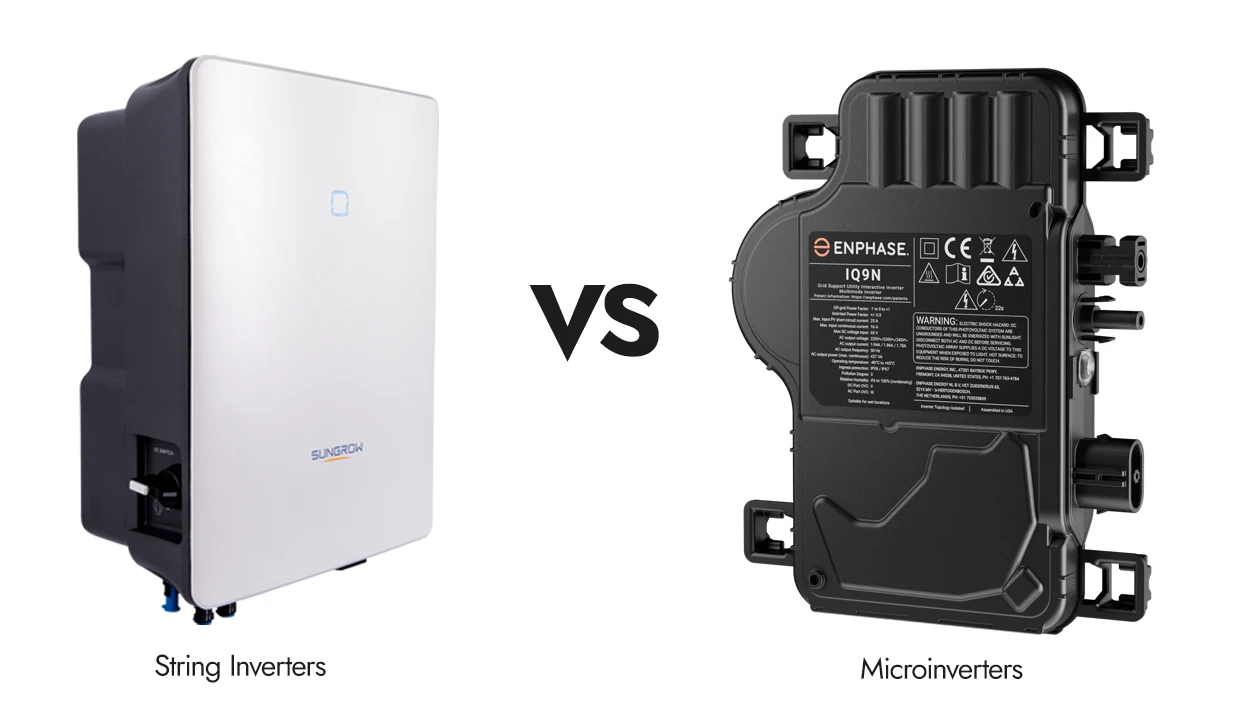
Microinverters are generally better for roofs with shading or complex angles because they convert power at each individual panel. String inverters are more cost-effective for unshaded, simple roofs but route all power through a single inverter. Your roof and budget decide.
Both do the same job: they convert the DC power your panels make into the AC power your home uses. The difference is where that conversion happens. New to solar? Here’s what a solar inverter does.
Use the flowchart, scorecard and quote checklist below to work out which suits your home. It takes about five minutes.
Are String Inverters or Microinverters Better? (The Selection Toolkit)
Microinverters usually win on total energy production and panel-level monitoring. String inverters usually win on upfront cost and ease of servicing. Each has a clear use case.
| String inverter | Microinverter | |
|---|---|---|
| Upfront cost | Lower | Roughly $2,000 to $3,000 more on a 6.6kW system |
| Shading performance | One shaded panel can drag down the whole string | Each panel works independently |
| Typical lifespan | Around 10 to 15 years | Built to match panel lifespan |
| Warranty | Usually 5 to 10 years | Up to 25 years |
| Repairs | Wall-mounted at ground level, easy to reach | On the roof, panel must be removed |
| Monitoring | Whole-system output | Panel-by-panel output |
| Adding panels later | May need a larger or second inverter | Add panels one at a time |
| Battery pairing | One hybrid inverter can run panels and battery | Pairs with a separate battery system |
Neither is better for every home. A string inverter on a clear, north-facing roof in Gosford will often perform almost as well as microinverters for less money. The same string inverter on a shaded, multi-angled roof in Terrigal could leave a noticeable amount of generation on the table every year.
The Decision Flowchart
Work through these questions in order.
1. Does your roof have trees, chimneys, vents, dormers or neighbouring buildings that cast shade on the panel area at any point during the day?
Yes: lean towards microinverters, or a string inverter with panel optimisers (small devices fitted under each panel that give a string inverter some of the shade tolerance of microinverters). See the reliability section before choosing optimisers.
No: go to question 2.
2. Will your panels face more than two different directions (for example north, east and west)?
Yes: lean towards microinverters.
No: go to question 3.
3. Is your main goal the lowest possible upfront installation cost?
Yes: a string inverter is likely your best fit.
No: go to question 4.
4. Do you want to see exactly how each panel is performing, or do you plan to add more panels in stages over time?
Yes: microinverters make this simple.
No: a quality string inverter will serve you well.
Best For
Microinverters are best for:
- Roofs with partial shading from trees, chimneys or neighbouring houses
- Complex roofs with panels spread across several directions
- Homeowners who want panel-by-panel monitoring
- Systems you plan to expand gradually
- Homeowners who want lower-voltage wiring on the roof, since microinverters convert to AC at each panel
String inverters are best for:
- Large, open, north-facing roofs with little or no shade
- Households working to a tighter budget
- Simple roof layouts with one or two orientations
- Ground-mounted solar arrays
- Homes planning a battery, where one inverter can run both the panels and the battery
Do This Now: Count Your Roof Planes
Open Google Earth or step outside and count the number of roof planes (flat sections facing different directions) you’d like to cover with panels.
- 1 to 2 planes: A string inverter is a strong, cost-effective option. Many modern string inverters have two separate inputs (called MPPTs) that can handle two roof orientations well.
- 3 or more planes: A standard string inverter starts to struggle. Ask your installer about microinverters or optimisers before accepting a string-only quote.
How Much More Do Microinverters Cost?
On a typical 6.6kW system, microinverters add roughly $2,000 to $3,000 to the price of a string inverter system on the Central Coast. The gap narrows on smaller systems and widens as you add panels, because each panel needs its own microinverter.
What Are the Downsides of String Inverters vs Microinverters?
Both technologies have trade-offs. Use the scorecard below to see which risks apply to your home.
The Roof Risk Scorecard
Give yourself one point for each statement that’s true for your home.
- ☐ Trees, chimneys, vents or nearby buildings shade part of the roof at some point in the day
- ☐ Panels will be installed on three or more roof planes
- ☐ Some panels will face east or west rather than north
- ☐ You want to monitor the output of each individual panel
- ☐ You’d like to add more panels in future
- ☐ Your roof is steep, high or difficult to access (count this one as minus one point, as it makes microinverter repairs harder)
Your score:
- 0 to 1: A string inverter is likely the smart, economical choice.
- 2 to 3: Either could work. Ask your installer to model expected generation for both options.
- 4 or more: Microinverters (or optimisers) are likely worth the extra upfront cost.
The String Inverter Weakness: The “Christmas Light Effect”
In a string system, panels are wired together in series and feed into one inverter. Think of an old set of Christmas lights. One weak panel holds back the whole string. If one panel is shaded, it can drag down the output of the other panels on that string.
Small shadow, big loss: Testing on a standard string system by the US National Renewable Energy Laboratory (NREL) found that a shadow can reduce power output by more than 30 times its physical size. Small shadows punch above their weight. A shadow from a vent pipe or TV antenna can cost far more generation than its footprint suggests. (NREL, Partially Shaded Operation of a Grid-Tied PV System)
Modern panels have built-in protection that limits this effect, and newer panel and inverter designs reduce it further, so the losses are rarely as dramatic on a new system. On a roof with shade moving across it through the day, though, they can still add up to a meaningful amount of power over a year. Microinverters sidestep this. Each panel works on its own.
Do Microinverters Actually Produce More Power?
On a sunny, unshaded roof, not by much. A University of Limoges study compared 200 solar systems in France and found both microinverter and string inverter systems achieved a performance ratio of around 79%. (pv magazine, Micro-inverters vs. string/central inverters) The advantage shows up when shade or multiple roof directions come into play.
The Microinverter Weakness: The “Roof Climb”
Microinverters sit on the roof, underneath each panel. If one fails, a technician has to get on the roof, remove the panel and swap the unit. On a steep or high roof, that job takes more time and may need extra safety equipment. That’s the catch.
A string inverter usually sits on a wall at ground level. It’s easy to reach and replace.
Action Plan: Check Your Quote for a Labour Warranty
Before you sign, check whether your installer’s quote includes a labour warranty, not just a manufacturer’s product warranty. The difference matters.
A manufacturer will often replace a faulty microinverter for free, but that doesn’t always cover the cost of someone climbing onto your roof to fit it. Without a labour warranty, you could be paying a call-out fee of a few hundred dollars for a part that’s technically under warranty. Ask your installer:
- How long is your workmanship and labour warranty?
- Does it cover the labour to replace a failed microinverter or string inverter?
- Who do I contact if the monitoring app shows a fault?
How Often Do Microinverters Fail? (Reliability and Warranties)
Quality microinverters from established brands have very low failure rates, and leading manufacturers back them with warranties of up to 25 years, matching the typical warranty on the panels themselves.
String inverters usually carry a 5 to 10 year warranty (sometimes extendable), and real-world data shows why most homeowners should plan for at least one replacement over the life of their system.
What the field data says: A Bern University of Applied Sciences study tracked 1,195 residential and small commercial solar systems containing 2,121 inverters, and found that 34.3% of inverters had their first failure within 15 years. The flip side: about two in three ran for 15 years without a fault that cut power output. (Bern University of Applied Sciences, Life Expectancy of PV Inverters and Optimizers in Residential PV Systems, 2022)
Two findings are worth acting on:
- Brand matters. The percentage of inverter failures varied by about a factor of three between manufacturers. Choose a well-established brand with a strong local support network rather than the cheapest unit on the quote.
- Placement matters. Inverters installed outside a building had a shorter time to failure than those installed inside. If your inverter has to go outdoors, ask your installer to mount it somewhere shaded and sheltered from rain and direct sun, such as a garage wall or the south side of the house.
Systems with power optimisers had roughly twice as many failures that cut output. An optimiser failure usually costs less power than a whole inverter going down, though. Keep that in mind if an installer pitches optimisers as a middle ground.
String inverters are still a good choice. Inverter replacement is a straightforward ground-level job, and a new inverter in ten or fifteen years’ time will likely be more efficient than today’s models. It’s simply a cost to factor into your long-term sums.
How to Check Your System Is Working
Whichever inverter you choose, your monitoring app is your early warning system.
- Download your inverter’s monitoring app (for example the Enphase app for Enphase microinverters, or the app that matches your string inverter brand).
- Check it weekly. With microinverters, the panel layout view shows each panel individually, so a failed unit appears as a single panel producing nothing. With a string inverter, watch for a sudden drop in daily generation compared with similar sunny days.
- Act quickly. Catching a fault within a week beats discovering it when your next quarterly electricity bill arrives higher than expected.
Does Tesla Use Microinverters?
No, Tesla does not use microinverters. Tesla’s current home energy setup, the Powerwall 3, has a built-in solar inverter that works like a string inverter. Your panels plug straight into the battery unit.
It’s a design built around the Powerwall. One unit handles both solar and storage, which keeps things compact.
Key Takeaway
Want the full Tesla setup? Your panels run through Tesla’s built-in inverter. If your roof is heavily shaded, ask about microinverter systems such as Enphase instead. They pair with batteries too.
Are Enphase Microinverters Worth It?
They’re worth it if your roof has shade, several roof planes, or you plan to add panels later. On a clear, north-facing roof, a quality string inverter usually delivers similar output for less.
Not Sure Which Suits Your Roof? Talk to Central Coast Energy
The flowchart and scorecard will point you in the right direction. Every roof is different, though, and the right answer comes down to how shade moves across yours through the seasons.
Our local team will look at your roof’s orientation and shading, then model the expected output of both a string inverter and a microinverter system. You’ll see the real numbers side by side, including the price difference, so you can choose with confidence.
Contact Central Coast Energy today to get a quote tailored to your roof.