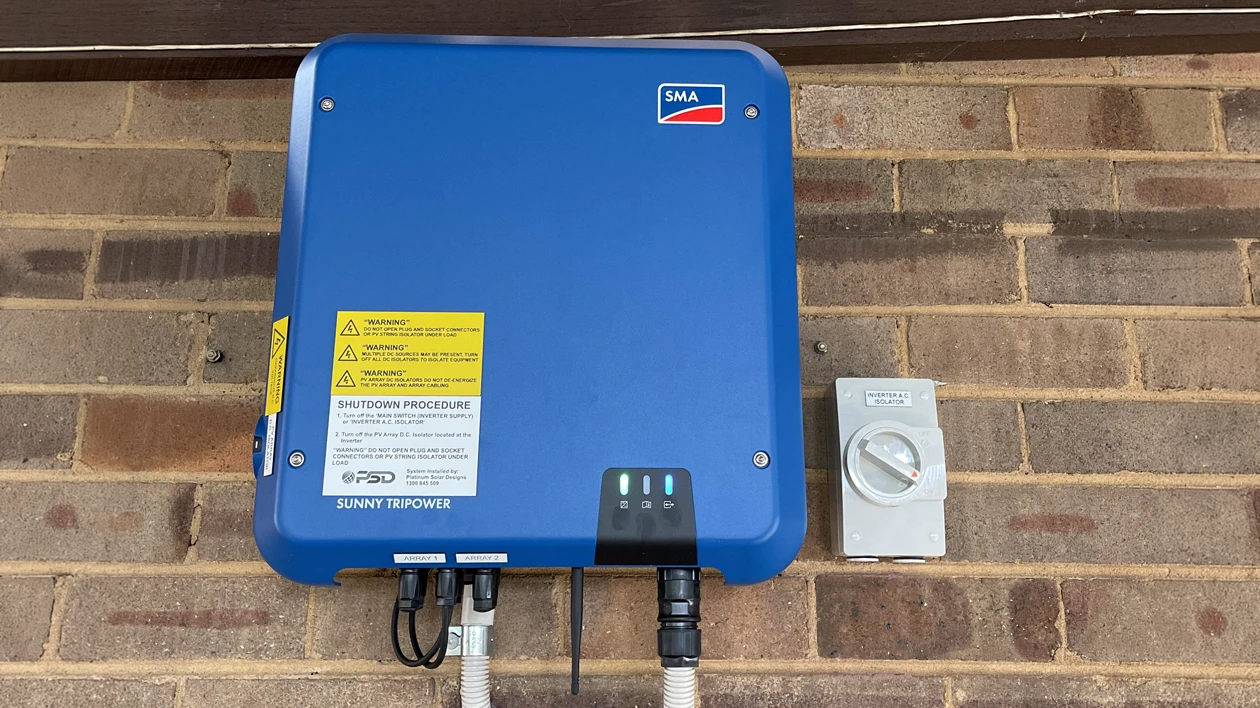
A solar inverter is a device that turns the DC power your panels make into 230V AC your home can run on. It’s what lets your appliances use solar power and lets you export surplus to the grid. No inverter, no usable power. Without one, the raw energy from your panels can’t safely run your house or feed into the grid.
Inside, the inverter does three jobs. It tracks the point where your panels produce the most power, a feature called maximum power point tracking (MPPT). It converts that DC power to AC in step with the grid. And it monitors the grid, shutting down if something goes wrong.
That’s the short version. The more useful question for most Central Coast homeowners is what kind of inverter setup suits your home, where it should go and what to do if it stops working.
How to Configure Your Solar System (With or Without Batteries)
Your inverter setup depends on what you want from solar: lower daytime bills, backup power at night or complete independence from the grid. An inverter is mandatory in every setup. A battery and an internet connection are optional, depending on the configuration you choose.
Here are the three system blueprints used across Australian homes.
Blueprint 1: Grid-Connected (No Battery)
Panels → Inverter → Switchboard → Home appliances and the grid
This is the setup on most Australian roofs today. Your panels generate DC power during the day, the inverter converts it to 230V AC, and your home uses what it needs. Any surplus is exported to the grid, and your retailer pays you a feed-in tariff for it.
Inverters are rated in kW, and they’re often smaller than the panel array they run. Our 6.6kW solar system guide explains why.
Best for: households that use a good share of their power during daylight hours and want the lowest upfront cost.
Blueprint 2: Hybrid (Battery Included)
Panels → Hybrid inverter → Home appliances, battery storage and the grid
A hybrid inverter manages three things at once: your panels, your battery and your grid connection. Daytime surplus charges the battery first, then any excess goes to the grid. At night, your home draws from the battery before buying power from your retailer. The battery covers the evening.
Best for: households that use most of their power in the evening, or anyone wanting backup power during outages. Backup capability depends on the inverter and how it’s wired, so confirm this with your installer.
Weighing up a battery? Our guide to solar battery costs in NSW breaks down current pricing.
Blueprint 3: Off-Grid
Panels → Charge controller → Battery bank → Off-grid inverter → Home appliances
Off-grid means no grid connection at all. The charge controller regulates power flowing into the battery bank, and the off-grid inverter draws from the batteries to run your home. Many modern off-grid inverters have the charge controller built in.
Best for: rural properties where a grid connection is unavailable or too expensive to run.
What to Do Now
- Check your feed-in tariff. Log in to your electricity retailer’s account or check your latest bill. A low feed-in tariff means using your own solar power (or storing it in a battery) is worth more than selling it.
- Check your switchboard. Older switchboards with ceramic fuses often need an upgrade before an inverter can be connected. Take a photo of yours and send it to your installer before quoting.
- Check your network’s export rules. On the Central Coast, Lake Macquarie and Newcastle, your network provider sets limits on how much solar you can export. Your installer handles the connection application, but it’s worth asking what export limit applies to your property.
Self-check: Look at any system design you’ve been given. If the panels connect directly to your household appliances with no inverter in between, the design is wrong and unsafe.
Is a Solar Inverter a Battery? Inverters vs Batteries vs Panels
Can solar panels work without an inverter? Not for your home. Panels make DC power, and your appliances and the grid run on AC. The only exception is a small 12V setup running DC appliances.
Panels generate power. Inverters convert power. Batteries store power. They’re completely different components that work together, and none can substitute for another.
| Component | What it does | Needed for |
|---|---|---|
| Solar panels | Generate DC electricity from sunlight | Every solar system |
| Inverter | Converts DC to 230V AC for your home and the grid | Every system powering household appliances |
| Battery | Stores surplus energy for later use | Night-time use, backup power, off-grid living |
| Charge controller | Regulates charging of a battery from panels | Off-grid and 12V systems (often built into hybrid and off-grid inverters) |
Which Components Do You Need?
Work through these questions in order:
- Do you only want to cut your daytime power bill? You need panels and a standard inverter.
- Do you want to use your own solar power at night? You need panels, a battery and a hybrid inverter (or a battery with its own inverter added to an existing system).
- Are you running a 12V setup in a caravan, shed or boat? A charge controller and 12V battery may be enough for DC appliances. You’ll only need an inverter if you want to run standard 230V appliances.
You’ll know you’re ready when you can name the three main pieces of hardware your goal requires before you call an installer. That puts you in charge when comparing quotes.
Common Mistakes to Avoid
- Never connect a solar panel directly to a 230V appliance. Bypassing the inverter will damage the appliance and creates a serious safety risk.
- Don’t assume every inverter can take a battery later. A standard string inverter can’t charge a battery on its own. If you think you’ll want storage in the next few years, ask about a battery-ready hybrid inverter now.
- Don’t attempt DIY installation. In Australia, grid-connected solar has to be installed by a licensed electrician, and you’ll need an accredited installer to claim the federal rebate. Your inverter should also appear on the approved inverter list, which confirms it has been tested to Australian standards.
- Don’t assume the inverter has been set up correctly. Every inverter installed in Australia has to be set to the current grid standard, AS/NZS 4777.2:2020, when it’s commissioned. It sounds like a box-ticking step, but it’s often missed.
When the Australian Energy Market Operator (AEMO) checked data from inverter manufacturers, it estimated only 37% of systems installed across the eastern and southern states in early 2022 were set to the correct standard. Most were left on the older 2015 settings, and some were set to overseas grid codes altogether. Ask your installer to show you the grid setting on the inverter display or in your commissioning paperwork. It should read AS/NZS 4777.2:2020, Australia A.
How Much Does a Solar Inverter Cost?
Most homeowners don’t buy an inverter on its own. It’s included in the price of a complete system, and our 6.6kW guide above covers current package pricing. Replacing an inverter on an existing system is a separate job, and the price depends on the brand, size and whether you want battery capability.
Should You Get an Inverter for Every Panel?
You can either use one central inverter for all your panels (a string inverter) or fit a small inverter to the back of each individual panel (microinverters). Some systems sit in between, using a string inverter with optimisers (small boxes behind each panel that reduce shading losses). Each suits a different roof.
| String inverter | Microinverters | |
|---|---|---|
| Setup | One unit for the whole system, usually on a wall | One small unit behind each panel |
| Shading impact | Shade on one panel can drag down the output of the whole string | Each panel works independently, so shade only affects that panel |
| Monitoring | System-level (panel-level with optimisers) | Panel-level as standard |
| Upfront cost | Lower | Higher |
| Common brands in Australia | Fronius, SMA, Sungrow, SolarEdge (with optimisers) | Enphase |
The third type is a hybrid inverter, which also manages a battery. It’s covered in Blueprint 2 above.
Roof Shading Self-Assessment
Go outside at 10am, 2pm and 4pm on a clear day. At each time, check whether a tree, chimney, neighbouring building or roof feature casts a shadow over the part of your roof where panels would go. Take a photo each time.
- Shade at one or more of those times: Microinverters or a string inverter with optimisers will protect your output.
- No shade at any of those times: A string inverter is usually the most cost-effective choice.
- Panels spread across several roof faces (for example, north, east and west): Microinverters, or a string inverter built to handle more than one roof face, will manage the different directions. Ask your installer which suits your roof.
Remember that trees grow. A tree that’s clear of your roof today may shade it in five years.
What Are the Downsides of a Solar Inverter?
An inverter usually won’t last as long as your panels. A string inverter loses output when one panel is shaded. Inverters also cut their output when they overheat. And a standard inverter can’t run your home in a blackout or charge a battery without a hybrid upgrade.
How Long Does a Solar Inverter Last, and Does It Work in a Blackout?
A string inverter typically lasts 10 years or more. That’s shorter than your panels, so most homeowners replace the inverter at least once over the life of their system. Check your paperwork for the manufacturer’s warranty, which varies by brand.
A standard grid-connected inverter also switches off in a blackout. That stops it sending power down lines that workers may be repairing. If you want power during outages, you need a battery and an inverter set up for backup.
The Inverter Placement and Connectivity Checklist
The ideal spot for a solar inverter is cool, shaded, well ventilated and close to your main switchboard. Shade matters more than you’d think. In Australia, that usually means a garage wall or a south or east-facing external wall, out of the harsh afternoon sun.
The Perfect Placement Audit
Run through this checklist at your proposed inverter location:
- Out of direct afternoon sun. Inverters cut their own output when they overheat, a process called temperature derating. A west-facing wall that cops full sun on a 35°C afternoon is one of the worst spots on the property.
- Protected from the weather. Most inverters are rated for outdoor use, but a sheltered spot under eaves or an awning extends their life.
- Close to the switchboard. A shorter cable run reduces wiring costs and energy losses. Your installer will confirm the right distance for your system.
- Room to breathe. Inverters need clearance around them for airflow. Don’t plan to box one into a cupboard.
- Away from bedrooms. Inverters can hum or have fans running during the day. A shared wall with a bedroom is worth avoiding if you have shift workers or young kids napping.
- Accessible. You’ll want to see the display and status lights, and your installer will need access for servicing.
Does a Solar Inverter Need Internet?
No. Your inverter generates and converts power without any internet connection. Wi-Fi is only needed for the monitoring app, which shows your generation, usage and any faults.
Monitoring is how you’ll spot problems early, so it’s worth getting right:
- Test your signal. Stand at the proposed inverter spot with your phone. If your signal is weak there, the inverter will probably struggle to stay connected.
- Fix it before installation day. Options include a Wi-Fi extender or mesh node, or running an ethernet cable to the inverter location. Some inverters also support a 4G monitoring module.
What Happens If Your Solar Inverter Stops Working?
Should your solar inverter be on all the time? Yes. It powers down into a sleep mode automatically at night when there’s no sunlight, and uses very little electricity while it waits for sunrise. On many models, night-time use is less than 1 watt. Leaving it on is normal and expected.
If your inverter stops producing power, work through this three-step check before calling anyone.
Step 1: Check the Lights and Display
Look at the inverter’s status light and screen during daylight hours.
- Green or normal status: The system is running. If your app shows nothing, it’s likely a monitoring issue (see Step 3).
- Flashing or amber: Often a warning or a start-up sequence. Check the display for a message.
- Red or fault: The inverter has detected a problem. Note the error code shown on the screen.
- Derating warning on a hot afternoon: This isn’t a fault. The inverter is reducing its output to protect itself from heat, and it goes back to full power once it cools. If it happens often, the inverter may need more shade or airflow, so mention it to your installer.
Normal night-time sleep also looks like “off”, so always check during the day.
Step 2: Check the Switchboard
Open your main switchboard and look for the circuit breaker labelled for solar or the inverter supply. If it has tripped, follow the shutdown and start-up procedure on the sign installed near your inverter or switchboard. Most systems have one. Reset it using that procedure.
Don’t keep resetting it. If the breaker trips again soon after resetting, leave it off and call your installer. Repeated tripping points to a fault that needs an electrician. Never open the inverter or touch the DC isolator switches, apart from what the shutdown procedure tells you to do. Solar panels produce high-voltage DC whenever the sun is shining.
Step 3: Check the App
Is the inverter actually faulty, or has it just lost its Wi-Fi connection? Usually it’s the Wi-Fi. If the lights on the inverter are normal but the app shows zero generation, check the connection first. Common causes include a new modem, a changed Wi-Fi password or a router moved further away. Your inverter will keep generating power while the app is offline.
When to Call Your Installer
If your inverter shows a red fault light during peak daylight, and the solar breaker is on, write down or photograph the error code and call your installer or book an [inverter repair]. Having the code ready speeds up diagnosis and helps get a warranty claim moving. Inverter warranties vary by brand and type, so check your paperwork to see what cover applies to yours. Don’t try to fix it yourself.
Getting the Right Inverter for Your Home
The inverter is often the part of a solar system people think about least, yet it determines how much of your panels’ output actually reaches your home. The right choice depends on your roof, your shading, your power usage and whether a battery is on the cards. There’s no one-size-fits-all answer.
Central Coast Energy is a CEC-accredited solar installer with around 15 years of experience across the Central Coast, Lake Macquarie, Newcastle and the Hunter Valley. We’ll assess your roof and recommend the right inverter setup. Every install is set to the current Australian grid standard and backed by our 10-year workmanship warranty.