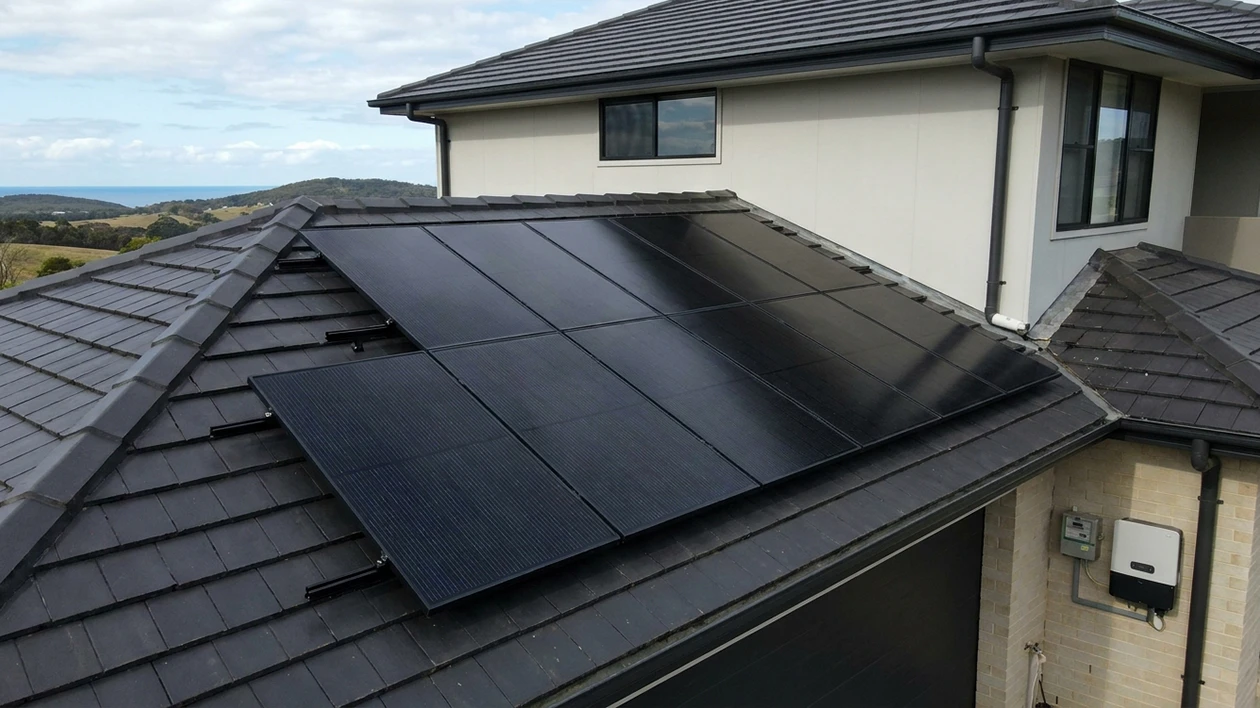
A 6.6kW solar system suits a smaller household with moderate electricity use, typically a two to three bedroom home with two or three occupants. That is the whole answer for most people. It generates around 26kWh a day on the Central Coast, which covers the daytime needs of a household running standard appliances without a pool, ducted air conditioning or an electric vehicle.
The average new rooftop system in NSW is 9.9kW, so 6.6kW is the smaller end of the range rather than the default. That is not a strike against it. Australian Energy Council modelling finds that smaller to mid-sized systems in the 3kW to 7kW range pay off faster than larger ones, which is where 6.6kW falls. For the right household, a system you consume from beats a system you export from.
Use the tools below to work out whether your bill and your appliances match what 6.6kW can deliver. Grab your latest quarterly bill before you start.
Is a 6.6kW Solar System Enough for Your Home?
A 6.6kW system produces around 26kWh a day averaged across the year. If your daily usage sits under 20kWh, it will cover your daytime consumption and export the surplus.
That figure is on your electricity bill, usually in the graph labelled “average daily usage”.
| Your bill shows | What that suggests |
|---|---|
| Under 15kWh a day | 6.6kW comfortably covers you, with room to add battery storage later |
| 15 to 25kWh a day | 6.6kW is a good match, provided you can shift load into daylight hours |
| Over 25kWh a day | 6.6kW is likely undersized. Read our 10kW solar system guide instead |
Do this now
- Log into your energy provider’s app or portal.
- Find your daily kWh average for a summer quarter and a winter quarter. The gap between them tells you how much of your load is heating and cooling.
- Compare both figures against the table above.
The annual average matters, but the summer to winter spread matters just as much. Say you average 18kWh a year. A hot February pushing you to 30kWh changes the answer.
Think ahead. Adding capacity later means additional labour, fresh approvals and sometimes an inverter change. If an EV, a pool or a battery is on the horizon, size for that now. Our guide to what size solar battery you need is worth reading before you commit either way.
What Can You Actually Run on a 6.6kW System?
A 6.6kW array is paired with a 5kW inverter, which means it can deliver a maximum of 5,000 watts at any given second no matter how many panels are on the roof. The constraint is not daily energy. It is instantaneous load.
For a two to three bedroom household during peak sun, that comfortably covers the fridge, lights, a washing machine, a dishwasher and a split system air conditioner running together.
The 5,000 watt checklist
Typical draw figures, indicative only.
| Appliance | Typical draw | Category |
|---|---|---|
| Electric oven | 2,500W | Heavy, one at a time |
| Clothes dryer | 2,400W | Heavy, one at a time |
| Dishwasher | 1,200W | Medium, two at a time |
| Vacuum | 1,200W | Medium, two at a time |
| Split system air conditioner | 1,200W | Medium, two at a time |
| Washing machine | 1,000W | Medium, two at a time |
| Laptops and TV | 200W | Background, always on |
| Fridge | 150W | Background, always on |
| Lights | 100W | Background, always on |
Start with your background draw, around 450W, then work upwards. One heavy appliance plus two medium ones lands near 4,850W, which sits just under the ceiling.
If your household runs ducted air conditioning at 3,000W or a pool pump at 1,500W, those loads are exactly why the average system size has climbed. They push a 6.6kW system past its comfortable range, and a larger array is usually the better answer.
Load shifting in three steps
- Set the dishwasher on a timer for 10:00am.
- Set the washing machine on a timer for 12:00pm.
- Pre-cool the house from 2:00pm rather than waiting until you get home at 6:00pm.
Try this tonight: put the dishwasher and washing machine on delay start so they run tomorrow between 10:00am and 2:00pm instead of after dark. It costs nothing and it is the highest-impact change most households can make.
Why this matters more than it sounds
The Australian Energy Council notes that the typical household consumes only about 30 per cent of the solar electricity it produces, with the rest exported, and that a battery can lift that figure past 80 per cent.
That first number is the one that matters. Seven in every ten kilowatt hours your panels make leaves the property, and you buy that energy back after dark at several times what you were paid for it.
Load shifting is how you move that number without spending anything. Every appliance you run between 10am and 2pm is a kilowatt hour you keep instead of sell. On a 6.6kW system producing around 26kWh a day, lifting self-consumption from 30 per cent to 50 per cent keeps an extra 5kWh a day inside the house. Our 10kW guide sets out the current NSW feed-in benchmarks if you want the numbers behind that gap.
Starting the oven, the dryer and the air conditioner at the same moment is the most common mistake. You exceed the 5kW inverter limit and the shortfall gets pulled from the grid at full retail rates while your panels sit there with capacity to spare. Stagger them.
Why Does a 6.6kW System Have a 5kW Inverter?
Panel capacity exceeding the inverter’s rated output is normal and deliberate. An oversized array keeps the inverter working efficiently in lower light, which means you generate usable power earlier in the morning, later in the afternoon and on overcast winter days. A 5kW array on a 5kW inverter would spend most of the year well under its rating.
Brief clipping on very sunny days is the expected trade-off, and you gain more in the early morning and late afternoon than you lose at midday.
Your installer is not short-changing you on the inverter. This is standard, deliberate design, and it is why almost every 6.6kW quote you receive will be structured the same way. For the basics of what the inverter is doing, see our guide to how a solar inverter works.
One caution: do not diagnose a system from the panel-to-inverter ratio on its own. Persistent or heavy clipping is worth a professional performance review, but the ratio by itself tells you very little. If an existing system is underperforming, our solar panel maintenance page covers what a service check involves.
Network approval is a separate matter from the ratio. Every new grid-connected system needs approval before energisation, and your installer should confirm the requirements that apply to your property in writing.
How Much Does a 6.6kW Solar System Cost in 2026?
A 6.6kW system installed on the Central Coast costs between $5,000 and $6,000. That is an indicative NSW price including GST and the usual upfront Small-scale Technology Certificate discount. Our solar rebates page explains how that discount is applied.
Anything advertised well under that range is usually cutting corners on the inverter, the mounting hardware or the installation labour.
How long until it pays for itself?
Australian Energy Council modelling puts solar payback in Sydney at roughly four to five years, and finds that smaller to mid-sized systems in the 3kW to 7kW range pay off faster than larger ones.
A 6.6kW system sits inside that band. This gets lost in most sizing conversations. A larger array generates more, but the extra generation is disproportionately exported, and exported electricity earns a fraction of what it displaces. If your household genuinely needs the capacity, size up. If it does not, the smaller system recovers its cost sooner.
Your own payback depends on your tariff and your consumption pattern. Mostly it depends on how much generation you actually use.
What moves the price within that range
| Factor | Effect on price |
|---|---|
| Panel and inverter selection | The largest single variable |
| Roof access and pitch | Two storey, tile or restricted access adds labour |
| Switchboard work | Older or non-compliant boards may need upgrading |
| Metering changes | Depends on your existing meter and retailer |
| Roof orientation | Split arrays across multiple faces add hardware |
Ask for these itemised rather than bundled into a single figure. Inverter type is a big one. Microinverters add roughly $2,000 to $3,000 on a 6.6kW system, and our guide to string inverters vs microinverters explains when they’re worth it.
If you would rather spread the cost, our finance options set out what is available.
The three question vetting script
Copy these straight into an email. The answers separate the serious installers from the rest quickly.
- “Are your installers CEC accredited, and do you use your own staff or subcontractors?” You want the accreditation number of the person who will physically be on your roof, not just the company’s credentials.
- “Does your quote include the STC discount upfront, and is it a fixed price contract?” A quote that quietly excludes the certificate discount looks cheap until the invoice arrives. Fixed price protects you from surprise switchboard or metering charges.
- “Will you do a site visit to check my switchboard before installation, or just look at Google Earth?” Satellite quoting is fast for the installer. It also misses old switchboards, undersized mains and shading you cannot see from a satellite image.
Ask what the workmanship warranty covers, and get it in writing. Ours is set out on our warranty page.
Next Steps
You now have three numbers that matter: your average daily usage, your peak instantaneous load, and your realistic budget. Take those into any quote conversation and you will be assessing installers rather than being sold to.
If your usage runs above 25kWh a day, or you have a pool, ducted air conditioning or an EV in the picture, read our 10kW solar system guide before you commit to anything. You can also browse our full range of residential solar options.
Do this now: send us a recent electricity bill and your half-hourly smart meter data if you can access it. We will model expected production, self-consumption and savings against your actual roof and usage.
Sources
Australian Energy Council, Solar Report Quarter 1 2025. Self-consumption figure, page 5. Payback modelling, page 16. View the report.