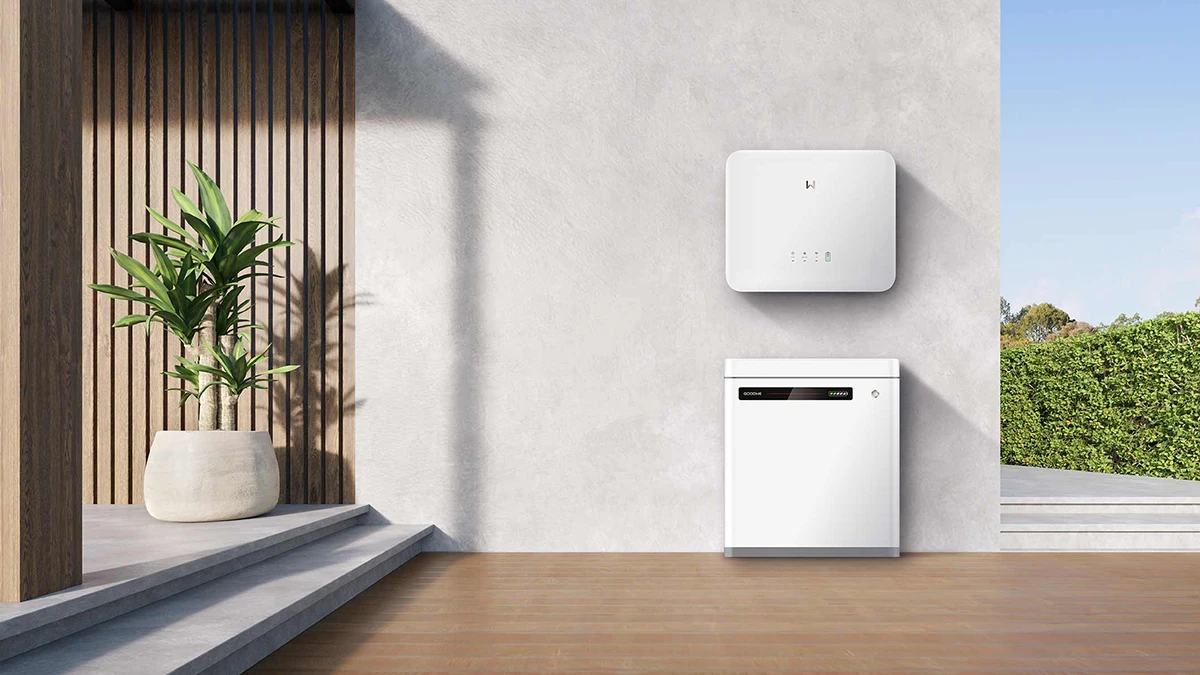
GoodWe batteries are lithium iron phosphate (LFP) home batteries designed to store your rooftop solar for use at night and during blackouts. They carry a 10-year warranty and switch to backup power in milliseconds. To get the most from them, the system needs to be wired correctly for backup and set up to meet the warranty conditions.
GoodWe sells three battery ranges in Australia:
- GoodWe ESA: an all-in-one system that combines the battery and inverter in one pre-wired unit. It suits new installs and adding a battery to an existing solar system.
- GoodWe Lynx Home F G2: a modular high-voltage battery from 9.6 to 28.8 kWh that pairs with a GoodWe EH or ET hybrid inverter.
- GoodWe Lynx Home U: a low-voltage modular battery from 5.4 to 32.4 kWh, compatible with GoodWe ES and SBP inverters.
Do GoodWe batteries have blackout protection?
Yes. How much of your home stays on depends on the model and the wiring.
Backup matters more here. In a submission to the Australian Energy Regulator, Central Coast Council noted that the Central Coast, along with Lake Macquarie and Port Stephens, records more average outage minutes than any other area on the Ausgrid network. Ausgrid targeted its resilience spending at the same three areas, which it says were among the hardest hit by the January 2025 storms.
The GoodWe ESA has built-in whole-home backup, with no separate backup gateway needed. It can pass up to 63 amps through to your home on the 8 and 10 kW single-phase models (smaller models pass less), and up to 80 amps on three-phase models. GoodWe quotes a switchover time of under 4 milliseconds for the hybrid ESA, and under 10 milliseconds for the AC-coupled version used when adding a battery to existing solar. Either is fast enough that most appliances, computers and Wi-Fi routers won’t notice the grid has dropped out.
The Lynx Home F G2 relies on the backup output of the GoodWe hybrid inverter it’s paired with. That output is usually wired to a separate backup sub-board covering your key circuits, such as the fridge, some lights and power points, and the internet. The rest of the house goes dark.
Backup is never automatic just because a battery is installed. It needs to be designed into the system at the quote stage.
Whole-home backup has limits too
A 63 amp whole-home connection doesn’t mean the battery can run everything at once during a blackout. In backup mode, your home is limited to what the inverter can deliver: 3 to 10 kW for a single-phase ESA, depending on the model. GoodWe’s specifications allow the ESA to briefly deliver double its rated power, for about 10 seconds, which helps start motors. Even so, ducted air conditioning, pool pumps and other appliances with big motors can trip the system if too much is running at once. Stagger the big loads.
The backup loads checklist
Work through this before you talk to an installer. It shapes the battery size, the inverter size and how your backup is wired.
| Load | Typical priority | Notes |
|---|---|---|
| Fridge and freezer | Must have | The most common reason people want backup |
| Lights (some or all) | Must have | LED lighting uses very little power |
| Wi-Fi router and modem | Must have | Keeps phones and work-from-home going |
| Medical equipment | Must have | Discuss with your installer before anything else |
| Power points in key rooms | Must have | Phone charging, TV, laptop |
| Garage door motor | Nice to have | Useful if it’s your only way in or out |
| Split system air conditioner | Nice to have | Check the battery’s surge capacity |
| Electric hot water | Usually left off | High draw, and the tank stays hot for hours |
| Oven and cooktop | Usually left off | Very high draw |
| Ducted air conditioning | Usually left off | Large start-up surge |
| Pool pump | Usually left off | Large start-up surge |
Setting up GoodWe backup, step by step
- Confirm the backup option for your model. For an ESA, ask whether you’ll have whole-home backup or a backup sub-board. For a Lynx battery, confirm your GoodWe hybrid inverter has a backup output.
- Decide what must stay on, using the checklist above.
- Have your installer wire for backup. Whole-home backup goes through the ESA’s bypass. Backup for selected circuits goes to a separate backup sub-board.
- Check the backup settings in the GoodWe SEMS+ app. Your installer should also set a backup reserve: a percentage of the battery held back for blackouts so it isn’t fully drained every night.
- Ask for a blackout test at handover. Your installer can switch off the grid supply and show you which circuits stay powered.
Try this now: Walk around your home and list three things you’d need during a blackout. Then open your switchboard and see whether those circuits are labelled and on separate breakers. If they aren’t, mention it when you get a quote, because rewiring or relabelling can add to the job.
Common backup mistakes
- Assuming any battery backs up the whole house. Many batteries back up selected circuits only, unless a gateway or bypass is included.
- Overloading the backup supply. Running the oven, kettle and air conditioner together during a blackout can trip the system.
- Setting the backup reserve to zero. If the battery has emptied overnight, there’s nothing left when the grid drops out the next morning.
- Not testing it. The first blackout shouldn’t be the first time you find out what’s connected.
Is a GoodWe battery any good?
Yes. GoodWe batteries are good value for money, with strong backup and a 10-year warranty. The main trade-off is that the ESA is newer than Tesla or Sungrow, so it has a shorter track record. It launched in Australia in 2025.
The ESA has quickly become one of the most popular batteries we install. It’s also easy to expand. Its strengths are cost per kWh, strong backup capability and flexible sizing. GoodWe has operated in Australia since 2012, with local support and warranty contacts.
How much does a GoodWe battery cost?
Installed GoodWe batteries in Australia typically cost around $11,000 for a 12.8 kWh Lynx Home F G2. A 16 kWh ESA usually costs $12,000 to $16,000, with around $14,000 typical. Those are national installed benchmarks published in 2026, before the federal rebate. With the current rebate taken off, that’s roughly $7,900 and $10,200.
| GoodWe battery | Usable capacity | Typical installed price before rebate | Rebate if installed May to Dec 2026 | Approx. price after rebate |
|---|---|---|---|---|
| Lynx Home F G2 | 12.8 kWh | ~$11,100 | ~$3,220 | ~$7,880 |
| ESA 16.6 | 16 kWh | ~$14,000 (range $12,000 to $16,000) | ~$3,810 | ~$10,190 |
Installed prices are national benchmarks and will vary by installer and site. Rebates are calculated using the current STC factor of 6.8, the tiered rate above 14 kWh, and an STC price of $37. The rebate drops on 1 January 2027. For a 16 kWh ESA, that means roughly $630 less.
You’ll also see GoodWe battery modules listed online for around $2,500 to $3,200 each. Those prices cover hardware only: one battery module, with no inverter, installation, wiring or rebate. They aren’t comparable with an installed quote.
What changes the price of a GoodWe battery
- Battery size. More modules cost more. Capacity above 14 kWh also earns a smaller rebate per kWh.
- Backup wiring. Whole-home backup or a new backup sub-board adds labour.
- Switchboard condition. Older switchboards often need an upgrade before a battery can be connected.
- Adding to existing solar or installing new. The ESA can be added to most existing systems, but the price depends on what’s already on your roof.
- Single-phase or three-phase power. Three-phase ESA models cost more.
What about the rebate?
The GoodWe ESA is on the Clean Energy Council approved list and qualifies for the federal Cheaper Home Batteries Program. For installations completed before 31 December 2026, an ESA 16.6 (16 kWh usable) attracts a federal rebate of roughly $3,800, and an ESA 25 (24 kWh usable) roughly $5,000. The rebate drops on 1 January 2027. Book early. Our solar battery rebate NSW guide has the full figures and dates, and our solar battery cost guide compares GoodWe with other brands.
How does GoodWe compare with Tesla and Sungrow?
| Feature | GoodWe ESA | GoodWe Lynx Home F G2 | Tesla Powerwall 3 | Sungrow SBR |
|---|---|---|---|---|
| Type | All-in-one battery and inverter | Battery only, pairs with a GoodWe hybrid inverter | All-in-one battery and solar inverter | Battery only, pairs with a Sungrow hybrid inverter |
| Chemistry | LFP | LFP | LFP | LFP |
| Capacity | Modular, 5 and 8 kWh modules, up to 48 kWh per stack | Modular, 3.2 kWh modules, 9.6 to 28.8 kWh | 13.5 kWh per unit, expandable | Modular, 3.2 kWh modules |
| Whole-home backup | Built in (up to 63 A single phase, 80 A three phase), no gateway | Through the inverter’s backup output | Through a separate Backup Gateway | Through the inverter’s backup output |
| Adds to existing solar | Yes (AC-coupled) | Needs a GoodWe hybrid inverter | Yes | Needs a Sungrow hybrid inverter |
| Weather rating | IP66 | IP55 | IP67 | IP55 |
| Warranty | 10-year product and performance | 10-year product and performance | 10 years | 10 years |
Specifications change regularly. Check the current datasheet for the exact model on your quote.
Is GoodWe better than Sungrow? Neither is better across the board. The GoodWe ESA is the stronger pick for whole-home backup and for adding a battery to existing solar, because it doesn’t need a matching hybrid inverter. Sungrow has a longer track record in Australia.
Which GoodWe battery suits your home?
Best for whole-home backup: GoodWe ESA. The built-in bypass means you can back up the whole house without buying a separate gateway. Battery modules can be stacked, and you can mix module sizes, so it’s easier to start smaller and expand later.
Best if you already have a GoodWe hybrid inverter: GoodWe Lynx Home F G2. If your existing system uses a compatible GoodWe EH or ET hybrid inverter, adding Lynx modules is often the simplest and cheapest way to add storage.
Choosing your GoodWe pathway
- No solar yet, or replacing an old inverter? Look at the GoodWe ESA. It covers solar, battery and backup in one system.
- Existing solar with a non-GoodWe inverter? The AC-coupled ESA can sit alongside your current inverter.
- Existing solar with a GoodWe hybrid inverter? Ask whether Lynx Home F G2 modules are compatible.
- Three-phase power? The ESA comes in three-phase models with an 80 amp bypass and larger inverter sizes.
- High evening use, an EV or plans to go all-electric? Look at larger ESA configurations. Keep in mind that rebate capacity above 14 kWh earns a reduced rate.
What is the GoodWe battery warranty?
GoodWe’s home ESA comes with a 10-year product warranty on the inverter and battery modules, and a 10-year performance warranty on the battery cells. The battery must keep at least 70% of its usable capacity for 10 years, or until it has delivered a set amount of energy: 29.2 MWh per 8 kWh module (18.25 MWh per 5 kWh module). Whichever comes first ends the cover. The Wi-Fi and 4G communication kits have a 2-year warranty.
The Lynx Home F G2 also carries a 10-year product warranty and a 10-year performance warranty based on 70% capacity or a throughput limit.
The warranty only holds if the installation meets GoodWe’s conditions.
Warranty compliance self-check
| Question | Why it matters |
|---|---|
| Is the battery installed out of direct sunlight? | GoodWe’s warranties exclude batteries exposed to direct sun. Operating temperature limits also apply. |
| Is the system connected to the internet and registered on SEMS+? | GoodWe’s Lynx warranties require an internet connection for monitoring. For any GoodWe battery, staying online lets your installer and GoodWe diagnose faults remotely. |
| Was it installed by an accredited installer? | GoodWe’s warranties exclude faults caused by faulty installation, and the rebate requires a Solar Accreditation Australia (SAA) accredited installer. |
| Is a Lynx battery paired with a GoodWe inverter? | Lynx batteries must be installed with a GoodWe brand inverter. |
| Have you kept your installation paperwork? | Claims need the model, serial number, installation date and proof of purchase. Faults must be reported promptly, within a month on the ESA. |
If you answered no to any of these
- Download the warranty document for your exact model from GoodWe’s Australian website.
- Check the SEMS+ app to see whether your system is showing as online. If it isn’t, reconnect it to your Wi-Fi or ask your installer to check the data connection.
- If the battery is in direct sun, ask your installer about relocating it or adding a shade structure, and take photos once it’s fixed.
- Keep copies of your invoice, the certificate of electrical compliance and the commissioning report together.
A warranty problem is much easier to fix now than after something has gone wrong.
How safe are GoodWe batteries, and how long do they last?
Safety
GoodWe batteries use lithium iron phosphate (LFP) chemistry. LFP is far more resistant to thermal runaway (the chain reaction behind battery fires) than the nickel manganese cobalt (NMC) batteries used in many older home batteries. It also contains no cobalt.
Home batteries are also a small part of the lithium-ion fire picture in NSW. Fire and Rescue NSW attended 762 lithium-ion battery fires between 2022 and 2024. Only 44 (about 6%) involved a solar battery, energy storage system or uninterruptible power supply (UPS), compared with 173 involving e-bikes, mobility scooters and similar devices. Cheap chargers and e-bikes are the bigger risk. A properly installed home battery isn’t.
The ESA adds several layers of protection on top of that:
- Multi-layer battery protection, which GoodWe describes as six layers running from cell level to system level.
- AI-driven arc fault detection (AFCI) on the solar input. It’s designed to detect and shut down dangerous electrical arcing in the panel wiring.
- An IP66 enclosure, sealed against dust and water jets, so it can be installed indoors or outside.
Key takeaway: LFP is the safest mainstream battery chemistry for homes. Where the battery is installed still matters. It should be in a well-ventilated spot out of direct sun, positioned to meet the Australian Standard for home battery installations (AS/NZS 5139). Your installer will check the clearances.
How long will a GoodWe battery last?
A GoodWe battery is warranted to keep at least 70% of its capacity for 10 years. The ESA’s battery modules are rated for 8,000 or more cycles in GoodWe’s lab testing, which is more than 20 years at one full cycle a day. That suggests the cells are built to outlast the warranty, although real-world life depends on heat, depth of discharge and how hard the battery works.
A battery doesn’t stop working once it reaches 70%. It holds less charge, so a 16 kWh battery at 70% still stores around 11 kWh.
The ESA warranty is written around one full cycle a day. Joining a Virtual Power Plant can add cycles and throughput, which may reach the warranty’s throughput limit sooner. Our Virtual Power Plant guide covers what to check before you sign up.
GoodWe battery installers on the Central Coast
The GoodWe ESA is one of our most-installed batteries across the Central Coast, Lake Macquarie and Newcastle. It’s a good fit if you already have solar and want to add storage, or if summer storms keep knocking your power out.
Every quote includes:
- battery sizing based on your bills
- a backup plan showing which circuits will stay powered
- the federal rebate taken off upfront
Not sure what size you need? Start with our guide to what size solar battery you need.